

Keywords
orbit
treatment
evolution
prognosis
Maradi
How to Cite
Abstract
Introduction :
Orbital cellulitis is a rare and serious emergency requiring early and appropriate management. The aim of this study was to investigate the epidemiological, therapeutic and evolutionary characteristics of orbital cellulitis.
Patients and methods :
this was a cross-sectional study with prospective collection, conducted in our ophthalmology department, from September 2020 to October 2022. Orbital cellulitis cases admitted and managed were included. Sociodemographic, clinical, therapeutic and evolutionary variables were recorded.
Results :
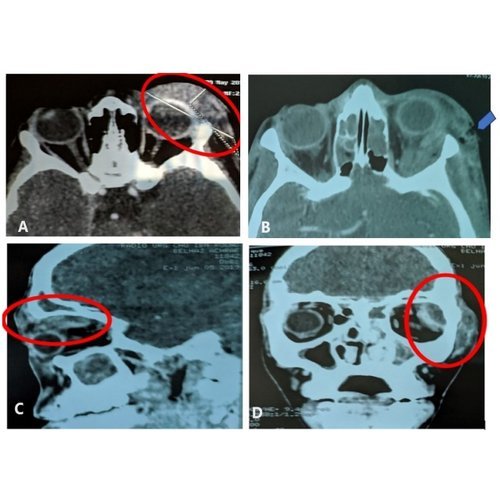
A total of 24 patients with orbital cellulitis were enrolled. The mean age of the patients was 19 years, with a sex ratio (M/F) of 2.4. Sinusitis was the etiology found in 58% (n=14), followed by traumatic origin in 21% (n=5). Clinically, the main findings were reduced visual acuity in 50% of cases (n=12), exophthalmos in 71% (n=17), and upper eyelid ptosis in 71% (n=17). CT scan analysis revealed 13 cases of pre-septal cellulitis (54%) and 11 cases of true orbital cellulitis (46%), including one case with the presence of an intra-orbital foreign body and a typical case of sub-periosteal abscess. Pus samples taken from 8 patients showed polymicrobial flora, dominated by staphylococcus aureus in 4 patients. Six patients (25%) underwent surgical treatment combined with medical therapy, which consisted of drainage of the abscess by orbitotomy. The outcome was favourable in 96% (n=....).
Conclusion :
Orbital cellulitis is a life-threatening, visual-threatening emergency. It is most often caused by sinusitis or oculo-orbital trauma. Retro-septal infections are the most severe, requiring investigation by thin-section imaging. Early and appropriate treatment is an important prognostic factor.
References
1. Anosike BI, Ganapathy V, Nakamura MM. Epidemiology and Management of Orbital Cellulitis in Children. J Pediatric Infect Dis Soc. 2022;11(5):214-220.
2. Ailal F, Bousfiha A, Jouhadi Z, Bennani M, Abid A. Cellulites orbitaires Chez l'enfant: à propos d'une étude rétrospective de 33 Cas. Med Trop (Mars). 2004; 64(4): 359-62.
3. Mouriaux F, Rysanek B, Cattoir V, Babin E. Infections Orbitaires. EMC Ophtalmologie. 2011;8(4):1-9.
4. Mekni M, Sayadi J, Choura, R, Fekih A, Gouider, D., Rouatbi, A., Zghal, I., Malek, I., Chebbi, A., & Nacef, L. (2022). Les cellulites orbitaires: Approche diagnostique, thérapeutique et pronostique dans un centre de référence à Tunis, Tunisie (une étude rétrospective sur 109 cas). Pan Afr Med J. 2020 ;43. doi: 10.11604/pamj.2022.43.64.34807.
5. Oxford LE, Mcclay J. Complications of acute sinusitis in children. Otolaryngol Head Neck Surg. 2005 Jul;133(1):32-7. PubMed | Google Scholar
6. Kevin D, Pereira KD, Mitchell RB, Younis RT, Lazar R. Management of medial subperiosteal abscess of the orbit in children: a 5 years experience. International Journal Of Pediatric Otorhinolaryngology. 1997; 38: 247-54.
7. Chaudhry IA, Shamsi FA, Elzaridi E, Al-Rashed W, Al-Amri A, Al-Anezi F, et al. Outcome of Treated Orbital Cellulitis in a Tertiary Eye Care Center in the Middle East. Ophthalmology. 2007 Feb;114(2):345–54.
8. Potter JN. Orbital Cellulitis: Medical and Surgical Management. J Clin Exp Ophthalmol. 2011:2–5.
9. Goodwin WJ, Weinshall M, Chandler JR. The role of high resolution computerized tomography and standardized ultrasound in the evaluation of orbital cellulitis. Laryngoscope. 1982 Jul; 92(7 Pt 1): 729-31.
10. Hodges E, Tabbara KF. Orbital cellulitis: review of 23 cases from Saudi Arabia. British Journal of Ophthalmology 1989 73(3):205-8.
11. Nagi S, Kaddour C, Jeribi R, et Coll. Thrombose de la loge caverneuse secondaire a une sinusite. Journal de radiologie, juin 2008 - Vol. 89 - N° 6 p. 803-805.
12. Kriss TC, Kriss VM, Warf BC. Cavernous sinus thrombophlebitis: case report. Neurosurgery. 1996 Aug; 39(2): 385-9. PubMed | Google Scholar
13. Kim BY, Bae JH. Role of systemic corticosteroids in orbital cellulitis: a meta-analysis and literature review. Braz J Otorhinolaryngol. 2022 Mar-Apr;88(2):257–262.
14. Younis RT, Lazar RH, Bustillo A Et Coll. Orbital infection as a complication of sinusitis: are diagnosis and treatment trends Changing ? Ear Nose Throat Journal. 2002 Nov; 81(11): 771-5.
15. Boivin L., Adenis J.P.: Infections orbitaires de l’enfant : clinique, imagerie et traitement; Journal Français d'Ophtalmologie (mai 2009), Volume 32, n° 5, pages 368-373.
16. Aïdan P, François M, Prunel M, Narcy P. Cellulites de la région orbitaire chez l'enfant. Arch Pediatr. 1994 Oct;1(10):879-85.
17. Israele V, Nelson Jd. Periorbital And Orbital Cellulitis. Pediatr Infect Dis J. 1987 Apr;6(4):404 10.
Metrics
Downloads

This work is licensed under a Creative Commons Attribution 4.0 International License.
Copyright (c) 2026 H Amadou Bouba Traoré, M Issiaka, L Laouali, S Iro, Y Abba Kaka, A Amza