

Keywords
Etiology
HNABD
Niamey
Niger
How to Cite
Abstract
Introduction :
Palpitations are a common symptom in cardiology practice. They can result from benign arrhythmias or, more rarely, from serious cardiac conditions. Our objective was to contribute to a better understanding of this symptom in the cardiology department of the Amirou Boubacar Diallo National Hospital (HNABD) in Niamey.
Patients and methods :
This was a retrospective descriptive study conducted over a period of nineteen (19) months, focusing on patients who presented to the department or were hospitalized for palpitations.
Results :
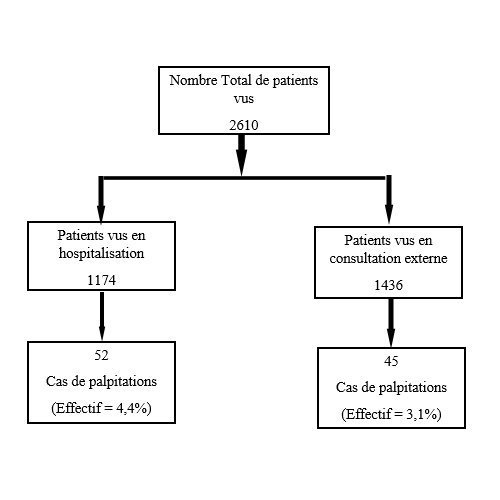
Ninety-seven patients were included, with a hospital incidence of 4.4% (n=52). The incidence of palpitations in outpatient consultations was 3.1% (n=45). The mean age of the patients was 56.5 ± 19.23 years, with a range of 19 to 100 years. The male-to-female ratio was 0.37. Patients with underlying heart disease and hypertension were the most represented, with respective frequencies of 36.9% (n=31) and 35.7% (n=30). More than half of the patients, 51.2% (n=43), reported rapid and irregular palpitations, with exertion being a trigger in 41.7% (n=35) of patients. Dyspnea was the symptom most frequently associated with palpitations (60.7%) (n=51). Arrhythmias were the predominant etiology, found in 64.3% (n=54) of cases; beta-blockers were the most commonly used medication for heart rate control, in 83.3% (n=45 of 54) cases.
Conclusion :
Palpitations were mainly related to arrhythmias, predominantly atrial fibrillation, requiring a rigorous diagnostic approach and appropriate management.
References
1. Gauer RL, Thomas MF, McNutt RA. Palpitations: evaluation, management, and wearable smart devices. Am Fam Physician. 2024;110(3):259-69.
2. Attias D, Pezel T, Lellouche N. iKB Cardiologie vasculaire EDN/R2C: cours + fiches. 10e éd. Paris: Vernazobres-Grego; 2024.
3. Collège National des enseignants de cardiologie, Société Française de Cardiologie. Médecine cardiovasculaire: réussir ses EDN. 3e éd. Issyles-Moulineaux: Elsevier Masson; 2025.
4. Giada F, Raviele A. Clinical approach to patients with palpitations. Card Electrophysiol Clin. 2018;10(2):387-96.
5. Wexler RK, Pleister A, Raman S. Outpatient approach to palpitations. Am Fam Physician. 2011;84(1):63-9.
6. Giada F, Raviele A. Diagnostic management of patients with palpitations of unknown origin. Ital Heart J. 2004;5(8):581-6.
7. Maisel AS, Peacock WF, editors. Textbook of Emergency Cardiology. 1st ed. New Delhi: Jaypee Brothers Medical Publishers; 2025.
8. Coulibaly A, Bâ HO, Camara Y, Diallo N, Traoré D, Sangaré I, et al. Apport du Holter ECG dans le diagnostic des troubles du rythme et de conduction cardiaques à Bamako et Kati. Cardiol Trop. 2020;(161).
9. Probst MA, Mower WR, Kanzaria HK, Hoffman JR, Buch EF, Sun BC. Analysis of emergency department visits for palpitations from the National Hospital Ambulatory Medical Care Survey. Am J Cardiol. 2014;113(10):1685-90.
10. Nwafor CE, Agbamoro J. Non-cardiac chest pain and benign palpitations among adult patients referred for stress electrocardiography in the cardiac clinic in Southern Nigeria. Int J Med Sci Health Res. 2024;8(2):13-22.
11. Salar Alcaraz ME, Buendía Santiago F, Flores Blanco PJ, García Alberola A, Pascual Figal DA, Manzano Fernández S. Usefulness of a smartphone-based event recorder for ambulatory patients with palpitations. Rev Esp Cardiol (Engl Ed). 2021;74(12):1114-6.
12. Halimi F, Sabouret P, Huberman JP, Ouazana L, Guedj D, Djouadi K, et al. Atrial fibrillation detection with long-term continuous Holter ECG recording in patients with high cardiovascular risk and clinical palpitations: the prospective AFTER study. Clin Res Cardiol. 2023;112(6):807-14.
13. Fonseca Vazao A, Gonçalves CM, Martins A, Amado M, Pereira JR, Carvalho M, et al. Diagnostic value of 24-hour Holter monitoring in nonagenarians: a single-center cohort study. Eur Heart J. 2025;46(Suppl 1):ehaf784.4063.
14. Institut National de la Statistique du Niger. Recensement général de la population et de l’habitat 2012. Niamey: INS; 2012.
15. Walker M, Patel P, Kwon O, Koene RJ, Duprez DA, Kwon Y. Atrial fibrillation and hypertension: quo vadis. Curr Hypertens Rev. 2022;18:39-53.
16. McLellan AJ, Kalman JM. Approach to palpitations. Aust J Gen Pract. 2019;48(4):204-9.
17. Hoefman E, Bindels PJE, van Weert HCPM. Efficacy of diagnostic tools for detecting cardiac arrhythmias: systematic literature search. Neth Heart J. 2010;18(11):543-51.
18. Du X, Dong J, Ma C. Is atrial fibrillation a preventable disease? J Am Coll Cardiol. 2017;69(15):1968-82.
19. Grundvold I, Skretteberg PT, Liestøl K, Erikssen G, Kjeldsen SE, Arnesen H, et al. Upper normal blood pressures predict incident atrial fibrillation in healthy middle-aged men: a 35-year follow-up study. Hypertension. 2012;59(2):198-204.
20. Aditya M, Sarat CK. Practical approach to the patient with palpitations. Fam Med Prim Care Rev. 2023;25(3):360-6.
21. Insulander P, Carnlöf C, Jensen-Urstad M, Schenck-Gustafsson K. Symptomatic palpitations causing anxiety in women: what are the underlying arrhythmias? Eur Heart J. 2019;40(Suppl 1):ehz746.1162.
22. Scott PA, Appleford P, Farrell TG, et al. Nurse-led palpitations clinic: a two-year experience. Postgrad Med J. 2010;86(1011):3-7.
23. Chiang LK, Ng L. Holter monitoring (ambulatory electrocardiography) defined cardiac arrhythmia among patients presented with palpitation in the primary care setting. J Fam Med Health Care. 2017;3(1):12-16.
Metrics
Downloads

This work is licensed under a Creative Commons Attribution 4.0 International License.
Copyright (c) 2026 B Dodo, K Souley, Y Oumarou, M Mossi, H Saley, M Arzika, S Moustapha, A Maliki, H Idrissa, S Brah, I Touré