

Keywords
trans-tibial traction
mutliresistant bacteria
How to Cite
Abstract
Introduction :
Osteoarticular infection is one of the most dreaded complications in Traumatology. Management of closed diaphyseal fractures of the femur in countries with limited resources is often deferred. While awaiting surgery, transosseous traction may be offered to reduce pain and limit muscle retraction. The aim of this study was to describe the difficulties encountered in the management of a case of chronic osteitis of the proximal tibia caused by multi-resistant Pseudomonas aeruginosa in the course of a trans-tibial traction pin.
Case report :
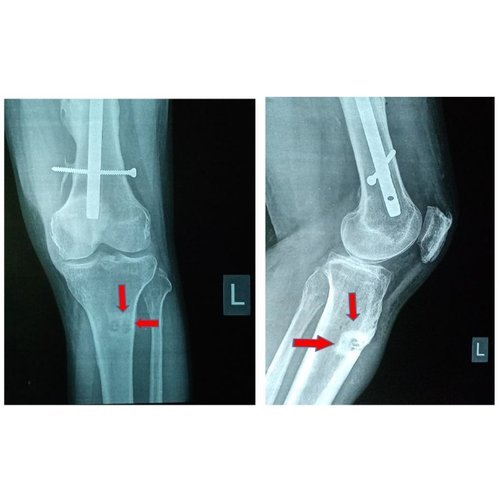
A 50-year-old man with no prior history was admitted the day after a bilateral closed femur fracture in a road traffic accident. He underwent emergency bilateral trans-tibial traction with bopped splints. Osteosynthesis of both femurs was performed 30 days and 60 days after the trauma. Bone consolidation was achieved in the third month for the left femur and in the fifth month for the right femur. However, on the trans-tibial traction paths, a Pseudomonas aeruginosa infection was identified, with a multi-resistant character on the left. The infection was treated surgically with wide excision of the soft tissue and surgical lavage, but adequate antibiotic therapy was not available due to lack of funds. This treatment resulted in healing on the right and an intermittent fistula on the left responsible for radiological osteolysis.
Conclusion :
Bone infections are difficult to treat, particularly when a multi-resistant germ is involved. This experience leads the authors to reinforce infection prevention and control measures in hospitals.
References
1. Elouennass M, El Hamzaoui S, Frikh M, Zrara A, Chagar B, Ouaaline M. Les aspects bactériologiques des ostéites dans un hôpital universitaire. Med Mal Infect. 2007; 37:802-8.
2. Tall M, Ouédraogo I, Kassé A, Tékpa B, Bonkoungou G, Belem S, et al. Cals vicieux du fémur traités par ostéotomie à ciel ouvert et enclouage centromédullaire dans les pays en développement. Rev Chir Orthop Traumatol 2012 ;98(7) :699-702.
3. Caubere A, Demoures T, Choufani C, Huynh V, Barbier O. Utilisation de l’enclouage centromédullaire en situation sanitaire dégradée : expérience du service de santé des armées francais. Rev Chir Orthop Traumatol 2019 ;105 :97-101.
4. Putz P. Bien placer une traction osseuse. Acta Orthop Belg. 1991;57(3):329-33.
5. Benndorf M, Bamberg F, Jungmann P. The Lodwick classification for grading growth rate of lytic bone tumors: a decision tree approach. Skeletal Radiol. 2022; 51:737–745.
6. Gosselin R, Lavaly D. Perkins traction for adult femoral shaft fractures: a report on 53 patients in Sierra Leone. Int Orthop. 2007; 31:697-702.
7. Mapping Antimicrobial Resistance and Antimicrobial Use Partnership. National situation of antimicrobial resistance and consumption Analysis from 2016-2018. Annual Report Sénégal; 2022 p. 111p. https://africacdc.org/download/mappingantimicrobial-resistance-and-antimicrobialuse-partnership-maap-country-reports/
8. Muylaert A, Mainil JG. Résistances bactériennes aux antibiotiques : les mécanismes et leur « contagiosité ». Ann Med Vét. 2012 ;156 :109-23.
Metrics
Downloads

This work is licensed under a Creative Commons Attribution 4.0 International License.
Copyright (c) 2026 O Goukodadja, R Haoudou, T Koudjo, A Padonou, M Boko, P Chigblo, A Hans-moévi