

Keywords
Epidemiology
Outcome
How to Cite
Abstract
Introduction :
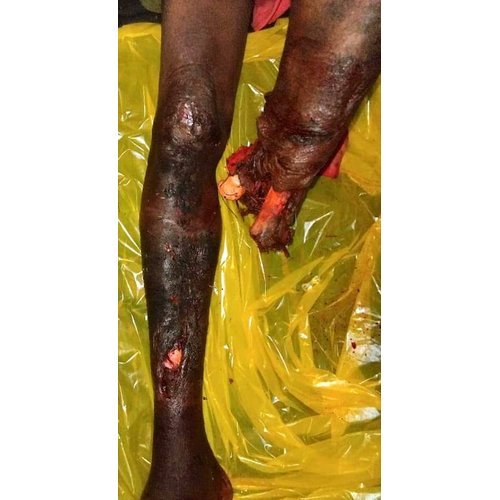
Traumatic limb amputation is a mutilating injury that primarily affects young, active individuals, and its consequences can be functional and/or psychological. The objective of this study is to describe the epidemiological aspects and the outcomes of patients who have undergone amputation due to traumatic causes.
Patients and Methods :
This was a 5-year retrospective cross-sectional study spanning from January 1, 2021, to December 31, 2025, with follow-up until March 2026, conducted in the surgery department of the Gaoua Regional Hospital in Burkina Faso. The socio-professional, clinical, therapeutic, and follow-up data of patients admitted to the department for amputations due to traumatic causes were analyzed.
Results :
One hundred and twenty-seven patients (113 men and 14 women) were included. The majority were artisanal gold miners (N=88) and traders (N=28). The mean age was 44.58 years. The mean admission delay was 1.44 days. The etiologies were dominated by accidents at gold mining sites (67 cases) and road traffic accidents (36 cases). The most frequent clinical contexts were polytrauma and artisanal mine blast hand injuries with polymorphic lesions. All patients underwent stump regularization or a salvage amputation. Complications were noted in 11 patients. At a mean follow-up of 24 months, 87.07% of the patients reported having at least an acceptable quality of life.
Conclusion :
Major limb amputations for traumatic causes are frequent in our context, especially with the rise of artisanal gold mining. It is an event that diminishes professional productivity and often leaves the patient handicapped due to the complex, polymorphic nature of the initial lesions.
References
1. Camilleri A. Amputations du membre inférieur et principes d’appareillage. Conf Enseign SOFCOT. 2003;80:263-86.
2. Dillingham TR, Pezzin LE, MacKenzie EJ. Limb amputation and limb deficiency: epidemiology and recent trends in the United States. South Med J. 2002;95(8):875-83.
3. Bisseriex H, Rogez D, Thomas M, Truffaut S, Compere S, Mercier H, Dochez F, Lapeyre E, Théfenne L. Les amputations dans les pays à faibles revenus : particularités de l'épidémiologie, de l'appareillage et de la rééducation. Med Trop (Mars). 2011;71(6):56571.
4. Johansen K, Daines M, Howey T, Helfet D, Hansen ST Jr. Objective criteria accurately predict amputation following lower extremity trauma. J Trauma. 1990;30(5):568-72.
5. Togawa S, Yamami N, Nakayama H, Mano Y, Ikegami K, Ozeki S. The validity of the mangled extremity severity score in the assessment of upper limb injuries. J Bone Joint Surg Br. 2005;87(11):1516-9.
6. Huskisson EC. Measurement of pain. Lancet. 1974;2(7889):1127-31.
7. Kpadonou GT, Fiossi-Kpadonou E, Lawson M, Alagnidé E, Houézo A, Gbaguidi M, AgossouVoyèmè K. Étio-épidémiologie des amputés transfémoraux à Cotonou. J Soc Biol Clin. 2007;11:40-4.
8. Pomares G, Coudane H, Dap F, Dautel G. Épidémiologie des amputations traumatiques des membres supérieurs. Rev Chir Orthop Traumatol. 2018;104(2):184-7.
9. Yinusa W, Ugbeye ME. Problems of amputation surgery in a developing country. Int Orthop. 2003;27(2):121-4.
10. Tidjani IF, Chigblo P, Madougou S, Alagnidé E, Lawson E, Ndeffo K, Hans-Moevi Akué A. Profil épidémiologique et clinique des amputations de membres de l'adulte à Cotonou. Rev Chir Orthop Traumatol. 2017;103(6):682-7.
11. Ministère de la Santé du Burkina Faso. Plan National de Développement Sanitaire (PNDS) 2011-2020. Ouagadougou: Ministère de la Santé; 2011. 57 p.
12. Office National de la Sécurité Routière (ONASER). Rapport général du forum national sur la sécurité routière. Ouagadougou: Ministère des Transports, des Postes et de l'Économie Numérique; 2012. 18 p.
13. Pomares G. Les amputations traumatiques du membre supérieur : le parcours des patients pour la reconstruction de leur identité corporelle [thèse de médecine]. Nancy: Université de Lorraine; 2020.
14. Verdan C. Syndrome of the quadriga. Surg Clin North Am. 1960;40(2):425-6.
15. Walla A, Amakoutou K, James EY, Ayouba G, Bakriga B, Abalo A, Dossim AM. Devenir des macro-amputés traumatiques du membre thoracique : cas d'un pays en développement. Eur Sci J. 2015;11(12):117-24.
16. Alexandre LGS, Tim S, Soft Tissue Foot & Ankle Group. Soft-tissue injury to the foot and ankle: literature review and staged management protocol. Acta Ortop Bras. 2019;27(4):223-9.
17. Faustin AT, Tsiagadigui JG, Ndando RP, Arabo MS, Bayiha A, Kenfack B. Décision d'amputation dans la prise en charge initiale d'une luxation ouverte grave de la cheville : à propos d'un cas observé à l'Hôpital Laquintinie de Douala, suite à un accident par moto-taxi. Pan Afr Med J. 2012;13:73.
18. Boukatta B, Bouazzaoui AE, Houari N, Jiber H, Sbai H, Kanjaa N. Syndrome de compression traumatique : à propos d'un cas. Pan Afr Med J. 2014;19:242.
19. Gnassingbe K, Walla A, Mihleudo-Agbolan K, Simkpa E, Goudjo E, Ndougssa I, AkakpoNumado GK, Tekou H. Écrasements de membres de l'enfant. Eur Sci J. 2015;11(21):500-8.
20. Fartit O. L'écrasement du membre inférieur : profil épidémiologique, diagnostic, thérapeutique, pronostic [thèse de médecine]. Marrakech: Université Cadi Ayyad; 2018.
21. Alexia M. Évaluation des facteurs de risque de reprise chirurgicale des amputations post traumatiques au membre inférieur : analyse de 10 ans d'activité au sein de l'Hôpital d'Instruction des Armées Percy [thèse de médecine]. Paris: Université Paris Cité; 2023.
22. Hiani A. L'appareillage de membres en traumatologie [thèse de médecine]. Marrakech: Université Cadi Ayyad; 2008.
23. Chalya PL, Mabula JB, Dass RM, Ngayomela IH, Chandika AB, Mbelenge N, et al. Major limb amputations: a tertiary hospital experience in northwestern Tanzania. J Orthop Surg Res. 2012;7:18.
24. Ménager D. Les amputations du membre inférieur et leur appareillage. Conf Enseign SOFCOT. 1993;45:177-96.
Metrics
Downloads

This work is licensed under a Creative Commons Attribution 4.0 International License.
Copyright (c) 2026 J Hien, B Some Ignin, E Tapsoba, N Dabire Mwinyanne, S Ouedraogo, D Kinda, M Soulama