

Keywords
cytogenetics
azoospermia
oligozoospermia
Niamey
How to Cite
Abstract
Introduction :
Couple infertility is a major public health problem today, due to its prevalence and the difficulties inherent in its management. The aim was to determine the role of cytogenetics in the investigation of male infertility in our context.
Methodology :
This was a retrospective, descriptive study carried out at the Histo Embryology-Cytogenetics and Cellular Pathology Laboratory of the Niamey Faculty of Health Sciences. The study was carried out over a 6-year period. Severe azoospermic and oligozoospermic patients who had undergone karyotyping were included. The analysis was based on spermogram results obtained in the laboratory.
Results :
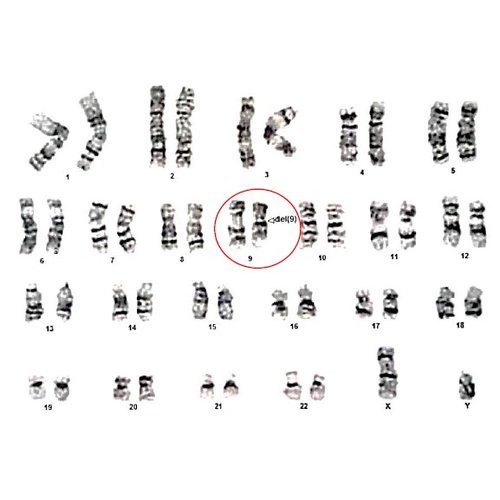
Of a total of 206 patients examined, 39 were severely azoospermic or oligozoospermic, representing a frequency of 18.93%. The mean age was 37.26 ±6.82 years. The 30-39 age group accounted for 56.41% of cases (n = 22). Primary infertility was found in 89.74% of patients (n = 35). Azoospermic patients were found in 87.18% (n = 34). Among patients with primary infertility, testicular atrophy and epididymal cyst constituted 15.40% (n = 6) and 2.56% (n = 1) of cases respectively. Chromosomal abnormalities were found in 12.82% of patients (n = 5), of which 10.26% (n = 4) were structural abnormalities such as deletions (46, XY, del (9) (q13)) and 2.56% (n = 1) were numerical abnormalities (47, XXY) such as Klinefelter syndrome. 10.26% (n = 4) of azoospermic patients had a chromosomal abnormality.
Conclusion :
The investigation of male infertility requires a multidisciplinary approach in which cytogenetics plays a major role. The study identified chromosomal abnormalities such as chromosome 9 deletion and Klinefelter's syndrome in the occurrence of male infertility.
References
1. Niang L, Ndoye M, Labou I, Jalloh M, Kane R, Diaw JJ, et al. Profil épidémiologique et clinique de l’infertilité masculine à l’hôpital général de Grand-Yoff, Sénégal : à propos de 492 cas. Androl. 2009; 19 :103-7. http://dx.doi.org/10.1007/s12610-009-0019-x
2. Rowe PJ, Comhaire FH, Hargreave TB, Mahmoud AMA, Borman MS, Everaert K, et al. WHO Manual for the Standardized Investigation and Diagnosis of the infertile couple. Cambridge University Press. 2000: 91. https://iris.who.int/handle/10665/42437
3. Hounnasso PP, Sikpa KH, Avakoudjo JDG, Fagla, Gandaho I, Yevi M et al. Profil spermiologique des hommes consultant pour infertilité à Cotonou. Uro’Andro. 2013 ; 1 (1) : 63-70.
4. Practice Committee of the American Society for Reproductive Medicine in collaboration with the Society for Male Reproduction and Urology. Evaluation of the azoospermic male: a committee opinion. Fertil Steril. mai 2018 ;109(5):777-82. https://doi.org/10.1016/j.fertnstert.2018.01.043
5. Ben Rhouma M, Okutman O, Muller J, Benkhalifa M, Bahri H, Ben Rhouma K, et al. Aspect génétique de l’infertilité masculine : de la recherche à la clinique. Gynécologie Obstétrique Fertilité & Sénologie. janv 2019 ;47(1):54-62. https://doi.org/10.1016/j.gofs.2018.11.004
6. Marcelli F, Robin G, Rigot JM. Prise en charge de l’infertilité masculine. Prog Urol. avr 2009;19(4):260-4. https://doi.org/10.1016/j.purol.2008.10.027
7. Kbirou A, Jandou I, Adnane E, Mohammed E, Moataz A, Mohammed D, et al. Profil épidémiologique et clinique de l’infertilité masculine : étude observationnelle transversale descriptive et analytique. Sexologies. juin 2022;31(2):117-22. https://doi.org/10.1016/j.sexol.2021.05.004
8. Tognifode MV, Lokossou S, Aboubakar M, Ogoudjobi M, Hounkpatin B, Tonato-Bagnan A, et al. Paramètres du spermogramme dans l’infertilité du couple: cas d’une clinique privée au Benin à propos de 210 cas. Journal de la société de Biologie clinique du Benin. 2018 ; (28) : 41-5.
9. Mwamba JJK, Mukuku O, Kasongo K, Tamubango HK, Kibwe CM, Tshikala IN, et al. Profil épidémio-clinique et séminal de l’homme consultant pour désir de procréation: état des lieux à Lubumbashi, en République Démocratique du Congo. Pan Afr Med J. août 2023;45:177. https://doi.org/10.11604%2Fpamj.2023.45.177. 36977
10. Wdowiak N, Wójtowicz K, Wdowiak-Filip A, Pucek W, Wróbel A, Wróbel J, et al. Environmental Factors as the Main Hormonal Disruptors of Male Fertility. J Clin Med. mars 2024;13(7):1986. https://doi.org/10.3390%2Fjcm13071986
11. Ndiaye M, Fall S, Gaye O, Sow Y, Fall P. Infertilité masculine : profil clinique et aspect thérapeutique dans notre centre. Prog Urol. nov 2022;32(3, Supplement): S88 9. https://doi.org/10.1016/j.fpurol.2022.07.102
12. Semet M, Paci M, Saïas-Magnan J, MetzlerGuillemain C, Boissier R, Lejeune H, et al. The impact of drugs on male fertility: a review. Andrology. juill 2017;5(4):640-63. https://doi.org/10.1111/andr.12366
13. Moussa D, Soumana A, Amadou SM, Soli I, Tahirou I, Ali A. Profil hormonal chez l’homme en cas d’infertilité au laboratoire de radio immunologie de l’institut des radioisotopes de Niamey. African Journal of Urology. 2016 ; 22(4) : 305-9. https://doi.org/10.1016/j.afju.2016.01.008
14. Halidou M, Amadou MI, Zakou ARH, Kodo A, Adamou H, Amadou S. Infertilité masculine à l’Hôpital National de Zinder : aspects épidémiologiques et cliniques. Health Sciences & Disease. 2022 ; 23(3) : 85-9. https://doi.org/10.5281/hsd.v23i3.3476
15. Khodari M, Ouzzane A, Marcelli F, Yakoubi R, Mitchell V, Zerbib P, et al. Azoospermie et antécédent de cure de hernie inguinale chez l’adulte. Prog Urol. oct 2015;25(12):692-7. https://doi.org/10.1016/j.purol.2015.06.008
16. Diop N, Dieng M, Sy M, Guèye MV, Diallo AS, Faye O, et al. Contribution à une meilleure analyse des paramètres spermatiques et échographiques testiculaires dans le suivi de l’infertilité masculine au laboratoire Histologie Embryologie Cytogénétique de l’UCAD. Morphologie. sept 2022;106(354, Supplement):S16. https://doi.org/10.1016/j.morpho.2022.06.084
17. Belhachemi N, Chenni K, Larbi D, Adelouahab A, Chafi B. Étude des facteurs pronostiques de survenue de grossesse chez les couples infertiles pris en charge en dehors de la fécondation in vitro par injection intracytoplasmique de spermatozoide dans l’Ouest Algérien. Journal de la faculté de médecine d’Oran. 2018 ; 2(4) : 293-302. https://doi.org/10.51782/jfmo.v2i1.61
18. Ammar-Keskes L, Chakroun N, Ben Hamida AS, Hadj-Kacem L, Bouayed-Abdelmoula N, Ayadi H, et al. Aspects cliniques et biologiques de l’azoospermie chez l’homme infertile en Tunisie. Androl. mars 2007;17(1):71-9. https://doi.org/10.1007/BF03041157
19. Amouri A, Hammami W, Kilani O, Bouzouita A, Ayed W, Ben Meftah M, et al. Chromosomal evaluation in a group of Tunisian patients with non-obstructive azoospermia and severe oligozoospermia attending a Tunisian cytogenetic department. C R Biol. avr 2014;337(4):223-8. https://doi.org/10.1016/j.crvi.2014.02.006
20. Naasse Y, Charoute H, El Houate B, Elbekkay C, Razoki L, Malki A, et al. Chromosomal abnormalities and Y chromosome microdeletions in infertile men from Morocco. BMC Urology. 18 sept 2015;15(1):95. https://doi.org/10.1186/s12894-015-0089-3
21. Ammar-Khodja F, Hamouli Z, Boukerbout F F, Djerroudib K. The cytogenetic aspect of male infertility. Iran J Reprod Med. déc 2014;12(12):835-6. https://pubmed.ncbi.nlm.nih.gov/25709642
22. Benchikh S, Bousfiha A, Razoki L, Aboulfaraj J, Zarouf L, Elbakay C, et al. Chromosome Abnormalities Related to Reproductive and Sexual Development Disorders: A 5-Year Retrospective Study. Biomed Res Int. 5 mai 2021;2021:8893467. ttps://doi.org/10.1155%2F2021%2F8893467.
Metrics
Downloads

This work is licensed under a Creative Commons Attribution 4.0 International License.
Copyright (c) 2026 I Hamadou, I Hamani, B Issa Oumarou, N Hama Aghali, M Alzouma Loumeye, L Yadji Guero, S Azonbakin, A Idrissa Massi, B Marou Soumana, A Attinine Soumana