

Keywords
ocular
congenital
cataract
glaucoma
Niamey
How to Cite
Abstract
Objective :
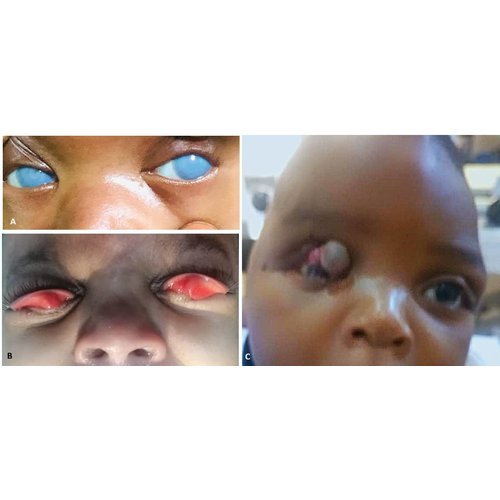
To describe the epidemiological and clinical aspects of congenital ocular malformations in the Ophthalmology Departments of HNABD and HNN.
Materials and method :
This was a prospective descriptive study of children with congenital ocular malformations in the ophthalmology departments of HNABD and HNN from March 1, 2023 to August 31, 2023, involving a total of 90 cases.
Results :
Of 997 children examined during the period, 90 (9.02%) were carriers of congenital ocular malformations, including 56 (62.22%) boys and 34 (37.78%) girls. The mean age at diagnosis was 1.6 ± 2.4 years (extremes: 1 months and 12 years). Leukocoria was the most common reason for consultation. The most frequent congenital ocular malformation was cataract (37.78%). Bilateral defects were predominant (64.44%). Congenital ocular malformations were isolated (76.66%), associated with systemic anomalies (10.01%), associated with each other (13.33%).
Conclusion :
The frequency of congenital ocular malformations is not negligible, and the age of diagnosis is high in our context. As a result, early screening programs should be instituted to detect congenital eye diseases at an early stage for optimal management.
References
1. Gilbert C, Rahi JS, Quinn GE. Visual impairment and blindness in children in: Johnson GJ, Weale RA, Minassian DC, West SK (eds). The epidemiology of eye disease, 2ndedition, London : Arnold Publishers. 2003 : 260-86.
2. A. Vinekar, I. Govindaraj, C. Jayadev et al., “Universal ocular screening of 1021 term infants using wide-0eld digital imaging in a single public hospital in India- a pilot study,” Acta Ophthalmologica, vol. 93, no. 5, pp. e372–e376, 2015.
3. H Soumana Diaouga, M Chaibou Yacouba, Rah M Garba, N Idi, M Nayama. La Cyclopie (Nouveau-Né avec un Seul Œil) : À Propos d’un Cas au Niger. Health Sci. Dis : Vol 23 (10) October 2022 pp 107-109.
4. Abba Kaka HY, Nouhou DA ; Laminou L ; Traoré HA ; Mamadou IC ; Roufaye L. Les Anophtalmies Syndromiques présentant un Tableau Polymalformatif sans Issue pour la Vision : A Propos de 3 Cas au Niger. Health Res. Afr: Vol 2 (4) Avril 2024 pp 107-109
5. Bénédicte Marèbe Diatewa et al. Les anomalies congénitales oculaires au Centre Hospitalier Universitaire-Campus de Lomé, Togo. Pan African Medical Journal. 2021 ;38(79). 10.11604/pamj.2021.38.79.21757.
6. Eballé AO, Ellong A, Koki G, Nanfack NC, Dohvoma VA, Mvogo CE. Eye malformations in Cameroonian children: a clinical survey. Clin Ophthalmol. 2012 ; 6 : 1607-11.
7. New York State Department of Health. Congenital malformation registry. Summary report. 2005. Accessed on July 17 2020.
8. Eventov Friedman S, Leiba H, Flidel Rimon O, Juster Reicher A, Shinwell ES. The red reflex examination in neonates: an efficient tool for early diagnosis of congenital ocular diseases. Isr Med Assoc J. 2010 ;12(5) : 259-61.
9. Mussavi M, Asadollahi K, Janbaz F, Mansoori E, Abbasi N. The evaluation of red reflex sensitivity and specificity test among neonates in different conditions. Iran J Pediatr. 2014 ;24(6) : 697-702.
10. lechie AA, Essuman VA, Enyionam S. Prevalence of congenital eye anomalies in a paediatric clinic in Ghana. EMHJ. 2014 ;19(3) : S76-80.
11. Assoumou PA, Mba Aki T, Sylla F, Kapinga Bulanda F, Traoré J, Mve Mengome E. Profil épidémiologique et clinique du glaucome congénital à l´Institut d´Ophtalmologie Tropicale d´Afrique. Bull Méd Owendo. 2018 ; 16 (44) : 21-7
12. Hendricks CH. Congenital malformations; analysis of the 1953 Ohio records. Obstet Gynecol. 1955 ;6(6) :592–8.
13. B.M. Diatewa N, Maneh A.S, Domingo, R, Mewamba Wamba, D. Amouzou, K. Didier Ayena, D et al. Association entre la consanguinité et les anomalies congénitales oculaires au Togo. Journal français d’ophtalmologie 2021 44, 63—66
14. kemmanu V, Gillyar SK, Rao HL, et al. Consanguinity and its association with visual imperment in southern India. The Pavagada Pediatric Eye disease. J Community Genet 2019 ;10 :345—50,
15. Al-Joborae SFF, Al-Sadik ERA, Al-Humairi AKH. A Study of the Association of Parental Consanguinity with Birth Defects and Neonatal Medical Problems in Babylon Province. JUBPAS 2018 ;26 :143—53.
16. Lawan A. Congenital eye and adnexial anomalies in Kano, a five-year review. Nigerian Journal of Medicine, 2008, 17 :37– 39.
17. Bermejo E, Matines-Frias ML. Congenital eye malformations: ClinicalEpidemiological Analysis of 1, 124,654 consecutive births in Spain. Am J Med Genet. 1998 ; 75(5): 497-504.
Metrics
Downloads

This work is licensed under a Creative Commons Attribution 4.0 International License.
Copyright (c) 2025 A Nouhou Diori, H Abdou Moussa, L Laouali, H Amadou Bouba Traoré, M Sani Brah, H Abba Kaka, A Amza