

Keywords
urethroplasty
endoscopic urethrotomy
recurrences
How to Cite
Abstract
Introduction :
The management of urethral stricture is a common but challenging activity in urology due to its recurrent nature. The objective of this study was to report the techniques and outcomes of urethral stricture management at the Zinder National Hospital (HNZ).
Patients and methods :
This was a cross-sectional study with prospective data collection conducted in the urology department of HNZ over a one-year period from June 1, 2022, to May 31, 2023. Patients diagnosed and treated for urethral resection (UR) were included. The parameters studied were both qualitative (treatment technique, postoperative course, results) and quantitative (age, number of URs, size of URs, length of stay). Data were analyzed using Excel 2016 and EPI Info™ 7.2.2.
Results :
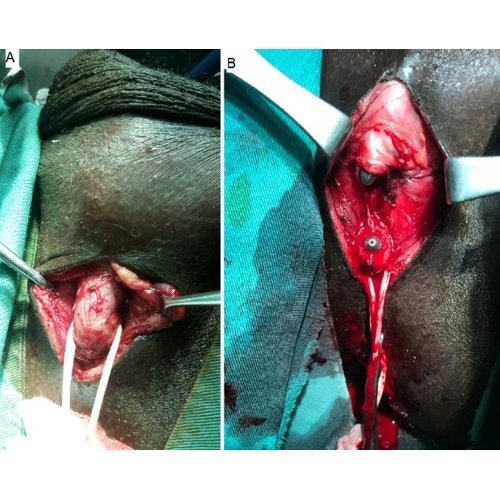
During the study period, 715 patients were registered, including 70 cases of urethral stricture, representing a hospital frequency of 9.79%. The mean age of the patients was 51.8 years. Retrograde and voiding urethrography (RVNR) aided in diagnosis in 100% of cases. The stricture was single in 84.29% of cases (n=59) and multiple in 15.71% of cases (n=11). Anatomically, the bulbar urethra was the most frequently affected, accounting for 67.14% of cases, followed by the membranous urethra (21.42%) and the penile urethra (11.42%). The length of the strictures ranged from 0.5 cm to 5 cm. Therapeutically, endoscopic internal urethrotomy (EIU) was the most commonly used technique, performed in 54.28% of cases. The length of the strictures varied from 0.5 cm to 5 cm. In terms of treatment, endoscopic internal urethrotomy (EUI) was the most frequently used technique, accounting for 54.28% of cases. Urethroplasty by segmental resection and end-to-end anastomosis was the second most common surgical option, used in 22.85% of cases, followed by two-stage urethroplasty in 7.15% of cases. In 8.58% of cases, patients underwent instrumental treatment (dilation with stents). The results were considered good: 100% of cases were successful at the time of catheter removal, compared to 82.85% at one month, and 69.81% at six months post-surgery.
Conclusion :
The management of strictures plays a significant role in the activities of the HNZ urology department. While the results obtained are satisfactory in the short term, they are characterized by a high recurrence rate in long-term follow-up.
References
1. Das S. Shusruta of India, the pioneer in the treatment of urethral stricture. Surg Gynecol Obstet. 1983;157(6):581–2.
2. Heyns CF, van der Merwe J, Basson J, van der Merwe A. Etiology of male urethral strictures: evaluation of temporal changes at a single center, and review of the literature. Afr J Urol. 2012;18(1):4–9.
3. Palminteri E, Berdondini E, Verze P, De Nunzio C, Vitarelli A, Carmignani L. Contemporary urethral stricture characteristics in the developed world. Urology. 2013;81(1):191–7.
4. Andrich D, Dunglison N. The long-term results of urethroplasty. J Urol. 2003;170(1):90–2.
5. Zango B, Kambou T, Sanou A. Urétrotomie interne endoscopique pour rétrécissement urétral acquis à l’hôpital de Bobo Dioulasso : faisabilité de la technique dans les conditions précaires et résultats à court terme. Bull Soc Pathol Exot. 2003;96(2):92–5.
6. Halidou M, Adamou H, Hassane DM, Amadou M, Magagi A, Adakal O. Profils épidémiologiques, cliniques et thérapeutiques de la sténose urétrale de l’homme à l’Hôpital National de Zinder (HNZ), Niger. Eur Sci J. 2020;16(9):103.
7. Hounnasso PP, Sanni RT, Avakoudjo JDG. Aspects épidémiologiques et diagnostiques du rétrécissement de l'urètre masculin au Centre National Hospitalier et Universitaire Hubert Koutoukou Maga de Cotonou. Rev Afr Urol Androl. 2015;1(3):165.
8. Kaboré FA, Zango B, Paré AK, Kirakoya B, Kambou T, Ouattara A, et al. Analyse rétrospective du traitement chirurgical d’une série de 148 cas de rétrécissements de l’urètre masculin au Burkina Faso. Rev Urol Androl. 2015;1(4):201–4.
9. Ndour NS, Diamé I, Diallo Y, Kouka SC, Ndiaye M, Diallo I, et al. Prise en charge du rétrécissement de l’urètre : notre expérience en milieu rural. Rev Urol Androl. 2019;1(11):532.
10. Nyongole OV, Akoko LO, Mwanga AH, Mkony CA. Urethral stricture as seen in Dar es Salaam, Tanzania. East Cent Afr J Surg. 2013;18(1):84–9.
11. Ngaroua, Eloundou NJ, Djibrilla Y, Asmaou O, Amvene JM. Aspects épidémiologiques, cliniques et prise en charge de sténose urétrale chez l’adulte dans un Hôpital de District de Ngaoundéré, Cameroun. Pan Afr Med J. 2017;26:193.
12. Feddal MS, Delporte G, Marcelli F, Villers A. Urétroplasties pour sténoses de l’urètre masculin : taux de succès et facteurs prédictifs. Prog Urol. 2022;32(8-9):426–34.
13. Diakité AS, Berthe HJG, Diakité ML, Coulibaly M, Sissoko I, Diallo MS, et al. Rétrécissements de l’urètre à l’hôpital Fousseyni Daou de Kayes à propos de 38 cas. Rev Urol Androl. 2020;2(3):104.
14. Cotter KJ, Hahn AE, Voelzke BB, Myers JB, Smith TG 3rd, Elliott SP, et al. Trends in urethral stricture disease etiology and urethroplasty technique from a multiinstitutional surgical outcomes research group. Urology. 2019;130:167–74.
15. Ze Ondo C, Fall B, Diallo Y, Sow Y, Sarr A, Ngongang R, et al. Les rétrécissements iatrogènes de l’urètre : expérience d’un hôpital sénégalais. Afr J Urol. 2015;21(2):144–7.
16. Yameogo AM, Ouattara A, Kaboré FA, Ky BD, Bougayiri A, Ouedraogo A, et al. Male anterior urethral stricture: epidemiological profile and management at Ouagadougou University Teaching Hospital (BurkinaFaso). Open J Urol. 2017;7(11):196–206.
17. Traore SI, Dembélé O, Maiga A, Traore S, Diallo AB. Prise en charge du rétrécissement urétral acquis : expérience du Service de Chirurgie Générale de Sikasso. Pan Afr Med J. 2019;33:328.
18. El-Merybety S. La prise en charge des rétrécissements de l'urètre chez l'homme (à propos de 43 cas) [Thèse]. Fès: Université Sidi Mohammed Ben Abdellah; 2016. 146 p.
19. Fall B, Ze Ondo C, Sow Y, Sarr A, Sine B, Thiam A, et al. Résultats de l’urétroplastie anastomotique pour rétrécissement de l’urètre masculin. Prog Urol. 2018;28(7):377–81.
20. Sikpa KH, Kpatcha TM, Tengue KK, Sewa EV, Botcho G, Soumanou F, et al. L’urétroplastie par résection anastomose terminoterminale pour rétrécissement de l’urètre masculin au CHU Sylvanus Olympio de Lomé au Togo. Afr J Urol. 2016;22(4):273–8.
21. Niang L, Fall PA, Bah I, Diao B, Sow Y, Ndoye AK, et al. L’urétrotomie interne endoscopique (UIE) : étude rétroprospective à propos de 61 cas. Dakar Med. 2011;56(3):412.
22. Moby EH, Makon S, Eyongueta D, Kamadjou C, Voundi-Voundi BT, Happy S, et al. Traitement des sténoses de l’urètre par urétrotomie interne endoscopique : profil épidémiologique, clinique et thérapeutique à Douala. Rev Med Pharm. 2018;8(1):775– 83.
23. Faridi MS, Sharma V, Sharma AK, Yadav R. Tunica albuginea versus buccal mucosa graft urethroplasty for anterior urethral stricture: a prospective randomised pilot study. Asian J Urol. 2022;9(4):450-456.
Metrics
Downloads

This work is licensed under a Creative Commons Attribution 4.0 International License.
Copyright (c) 2025 A Kodo, A Zakou, M Halidou, Z Mahaman Balarabe, A Ouatara