

Keywords
Epidemiology
Black skin
Initial herald patch
Seasonal variations
Niger
How to Cite
Abstract
Introduction :
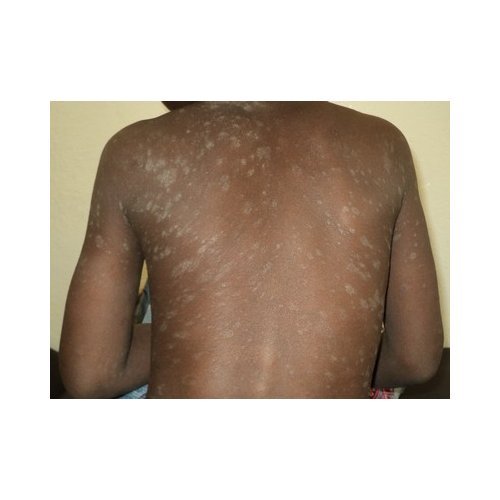
Pityriasis Rosea of Gibert (PRG) is an acute inflammatory skin disease characterized by erythematous-squamous lesions. The lesions are benign and self-resolving within a few weeks; however, their unsightly and emotional impact requires symptomatic treatment. This work aim to study the epidemiological, clinical, and therapeutic aspects of PRG in the Dermatology-Venereology Department of the National Hospital of Niamey.
Materials and methods :
This was a cross-sectional study with retrospective data collection carried out over a period of 3 years (January 1, 2018, to December 31, 2020) in the Dermatology-Venereology Department of the National Hospital of Niamey.
Results :
Out of a total of 6,680 consultations, 88 cases of PRG were diagnosed, corresponding to a frequency of 1.32%. The average age of the patients was 17.44 years. Women accounted for 61.36% (n = 54), and the sex ratio (F/M) was 1.58. Schoolchildren/students were the most affected group (48.86%). The most common predisposing factor was atopy (20.45%). PRG occurred annually with two monthly peaks: March and June. In 48.86% (n = 43) of cases, PRG had been evolving for less than 2 weeks at the time of consultation. Clinically, PRG was pruritic in 5.68% (n = 5) of the patients. The initial herald patch was found in 65.90% (n = 58) of cases. The classic form accounted for 80.68% (n = 71). The most frequent locations were the trunk (67.04%) and limbs (32.95%). Topical corticosteroids, used in 77.27% of cases and combined with emollients, helped accelerate lesion remission in 85.22% of patients.
Conclusion :
PRG is a benign and perennial skin condition that mainly affects young individuals. Recognizing the clinical features of PRG is essential to make a correct diagnosis and avoid inappropriate treatment. The use of topical corticosteroids and emollients has helped accelerate lesion remission in our context.
References
1. Villalon-Gomez JM, Pityriasis Rosea : Diagnosis and treatment. Am Fam Physican.2018.Jan 1 ; 97(1) :38-44.
2. Mahroum N, Shoenfeld Y. Classic Pityriasis Rosea. Isr Med Assoc J. 2022 Aug ; 24(8) : 549.
3. Leung AKC, Lam JM, Leong KF, Hon KL. Pityriasis Rosea : An UpdatedReview. CurrPediatrRev. 2021 ; 17-3) :201-211.
4. Ganguly S. A clinico-epidemiologicalstudy of pityriasis rosea in South India. Indian J DermatolVenereolLeprol. 2013 ; 79 : 42-46.
5. Mahajan K, Relhan V, Relhan AK, Garg VK. Pityriasis Rosea : An Update on etiopathogenesis and management of difficult aspects. India J Dermatol. 2016 Jul-Aug ; 61(4) : 375-84.
6. Agbessi N, Degboe B, Houngbo O, Keutcha L, Akpadjan F, Adegbidi H, et al. Profil clinique, comorbidités et qualité de vie des patients atteints du Pityriasis Rose de Gibert à Parakou (Benin). Health Sciences and disease 2021 ; 22(3) : 4360.
7. Morand JJ, Lightburne E. Dermatologie des peaux génétiquement hyperpigmenté (dites peaux noires). EMC – Dermatologie. 2009 ; 4-150-A-10 : 1-16
8. Petit A. Pityriasis rosé. In: Encyclopédie Médico-Chirurgicale. Paris: Elsevier Masson; 2006. Dermatologie, Fascicule 9-320-A-10.
9. Ayanlowo O, Akinkugbe A, Olumide Y. the Pityriasis Rosea calendar : A 7 year review of seasonal variation, age and sex distribution. Nig Q J Hosp Med.2010 Jan-Mar ; 20 (1) : 29-31.
10. Traore A, Korsaga-Some N, Niamba P, Barro F, Sanou I, Drabo YJ. Pityriasis Rosé de Gibert dans les écoles secondaires à Ouagadougou. Ann DermatolVenereol. 2001 May ; 128(5) : 605-9.
11. Yahya H. Pityriasis Rosea in kaduna, NorthWest Nigeria : A 20 year experience. West Afr J Med. 2023 ; 40(8) : 816 -821.
12. Joshi TP, Calderara GA, LipoffJB. Prevalence of Pityriasis Rosea in the United States : A Crosssectional study using the All of Us database. JAAD int.2022 May 19 ; 8:45- 46.
13. Amer A, Fischer H, Li X, The naturalhistory of pityriasis rosea in black americanchildren : How correct is the classic description ? Arch PediatrAdolesc Med. 2007 May ; 161(1) :503-6.
14. Ehsani A, Esmaily N, Noormohammadpour P, Toosi S, Hosseinpour A, Hosseini M, et al. The comparison between the efficacy of high dose acyclovir and erythromycin on the period and signs of pitiriasis rosea. Indian J Dermatol. 2010;55(3): 246-8.
15. Drago F, Ciccarese G, Parodi A (2018). Pityriasis Rosea and Pityriasis Rosea-likeeruptions : How to distinguishthem ? JAAD Case Reports, 4(8), 800-801.
16. Urbina F, Das A, Sudy E. ClinicalVariants of pityriasis rosea. World J Clin Case. 2017 Jun 16 ; 5(6) : 2023-211.
17. Kilinc F, Akbas A, Sener S, Aktas A. Atypical pityriasis rosea : Clinicalevaluation of 27 patients. CutanoculToxicol. 2017 jun ; 36(2) : 157 – 162.
18. Daze RP, Dorton D. An atypicalPresentation of Pityriasis Rosea localized to the extremities. Cureus.2020 Aug 15 ; 12(8) :e9765.
19. Chuh A, Zawar V, Sciallis G, Kempf W. A position statement on the manegement of patients with pityriasis rosea. J Eur AcadDermatolVenereol.2016 Oct ; 30(10) : 1670 -1681.
Metrics
Downloads

This work is licensed under a Creative Commons Attribution 4.0 International License.
Copyright (c) 2025 M Laouali Idi, L Salissou, M Ouédraogo, K Issa Abdou, S Ousmane, M Gado, R Halidou Sidibé, A Abdourahamane, A Inouss Issa, M Harouna, A Ango, M Abdoulaye