

How to Cite
Abstract
Introduction :
Necrotizing fasciitis (NF) during pregnancy is rare but potentially fatal, with high rates of morbidity and perinatal mortality.
Observation :
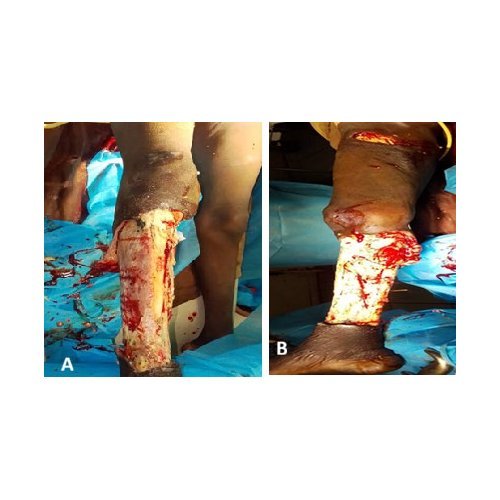
A 20-year-old pauciparous woman presented to our department with metrorrhagia, abdominal distension and pain associated with an abscess of the thigh and right leg in a febrile context, at 39 weeks of pregnancy. Clinical and paraclinical examination and exploratory laparotomy led to a diagnosis of uterine rupture that had been developing for seven days, complicated by necrotizing fasciitis and fetal death. The patient received multidisciplinary care including a total hysterectomy, meticulous surgical debridement of necrotic tissue in the pelvic region, and a maternal resuscitation protocol. She was then transferred to a specialized surgical unit for further care, where her clinical and biological progress was favorable. However, the patient was discharged from hospital against medical advice due to lack of financial resources on day 30 of hospitalization.
Conclusion :
This observation shows that uterine rupture can be an overlooked cause of NF, the diagnosis and management of which can be difficult in resource-limited settings.
References
1. Nikolaou M, Zampakis P, Vervita V, Almaloglou K, Adonakis G, Marangos M et al. Necrotizing fasciitis complicating pregnancy: A case report and literature review. Case Reports in Obstetrics and Gynecology; 2014, Article ID 505410, 4P http://dx.doi.org/10.1155/2014/505410.
2. Oud L, Watkins P. Necrotizing fasciitis associated with pregnancy: a PopulationBased Cohort Study. Infect Dis Ther 2014; 3(1):307–320 rupture utérine et FN reste spéculatif : propagation hématogène ou lymphatique de germes vaginaux via la dextrorotation utérine est plausible, mais non prouvée sans histologie ou PCR. crosante au cours de la grossesse. isation FN Contexte Issue maternelle s Rupture utérine Favorable minale segmentaire post accouchement vaginale s Rupture utérine Favorable minale segmentaire post accouchement vaginale bre Rupture utérine Favorable (J30) eur fondique à 39 SA
3. Bouzida M, Bassir A, Fakhir B, Harou K, Boukhanni L, Aboulfalah A et al. Fasciite nécrosante de la paroi abdominale postcésarienne. Int. J. Adv. Res 2024; 12(01), 1078-1082.
4. Kang-Augera G, Chassé M, Quachd C, Ayoub A, Auger N. Necrotizing fasciitis: Association with pregnancy-related risk factors early in life. Yale Journal of Biology and Medicine 2021;94 (1):573-584.
5. Foeller ME, Sie L, Foeller TM, Girsen AI, Carmichael SL, Lyell DJ et al. Risk factors for maternal readmission with sepsis. Am J Perinatol 2020; 37(5):453–60.
6. Onuh S, Godard A, Pilasi C, Salifou D.A, Aliyu F, Nakisembo M et al. Necrotizing soft tissue infection of the abdominal wall following vaginal delivery in a ruptured uterus: a case series from Nigeria. J Surgical Case Rep, 2025, 9, rjaf675. https://doi.org/10.1093/jscr/rjaf675.
7. Morgan MS. Diagnosis and management of necrotising fasciitis : a multipara metric approach. J Hosp Infect 2010; 75(1): 249-57
8. Roujeau JC. Hypodermites et fasciites nécrosantes: critiques cliniques et facteurs de risque. Médecine et Maladies Infectieuses 2000; 30(1): 399-405
9. Eckmann C, Montravers P. Current management of necrotizing soft-tissue infections. Current Opinion in Infectious Diseases. 2021;34(1):89–95.
10. Khoo CL, Meskhi A, Harris CP. Fatal clostridium septicum fol lowing medical termination of pregnancy. J Obst Gynecol 2013;33(1): 530–1.
11. Yagi H, Fukushima K, Satoh S, Nakashima Y, Nozaki M, Nakano H. Postpartum retroperitoneal fasciitis: a case report and review of literature. Am J Perinatol. 2005 Feb;22(2):109-13.
Metrics
Downloads

This work is licensed under a Creative Commons Attribution 4.0 International License.
Copyright (c) 2026 H Soumana Diaouga, Y Boka Tounga, YZ Kossi Odjo Dogbe, M Chaibou Yacouba, R Garba, M Nayama